

Once upon a time there was a girl who learned to knit. First she knit some very wonky scarves, then some somewhat better hats, then a set of fingerless mitts or two. She started out with 99 cent Red Heart super saver acrylic and eventually graduated to cotton and then wool, and some of her creations started to actually be wearable by her friends and family.
For many years scarves and hats and baby sweaters made her happy, but one day the girl realized she was so very cold and no amount of scarves and hats would warm her and she couldn't wear those baby sweaters herself, cute as they were. What she really needed was a nice cozy sweater of her very own...
But the first sweater she knit (see top) was much too SMALL. "I can't breathe!" she declared, and into the charity donation pile it went.
Her second sweater was far too BIG. "I'm drowning in saggy baggy yarn!" she cried and into the refashioning pile it went:
Eventually she learned a few lessons about ease and knitting and fiber choice and...
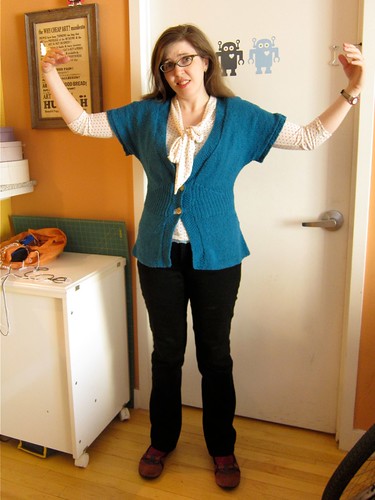
Her third sweater was JUST RIGHT.

And she lived happily ever after and never had any knitting fitting problems again! (Right? Right?)
So what's the magic secret to ensure a sweater you've labored and sweated over for months will actually fit when it's all blocked and sewn and finished up?
... Well, there isn't one. But I've learned over time there are a few ways you can give yourself a fighting chance!:
- Pay close attention to gauge -- and wash that gauge swatch the way you would the final sweater. I used to always skip that step out of impatience, but with my Georgina cardigan I did things right and actually washed and BLOCKED swatches of both stockinette and the lace pattern to be absolutely certain my gauge was right-on:

- Err slightly on the side of small. Negative ease is your friend. When I browse through finished sweaters on Ravelry, the number one issues I notice (and the main sweater issue my knitting friends seem to complain about) is too-baggy sweaters, like my second sweater above.
If, like me, you like a nicely fitted curve-hugging sweater, you'll want to knit to final measurements at LEAST an inch or two (but probably a bit more) smaller than your actual bust and waist so that your sweater stretches to fit. You want to aim for this effect:
And not this effect:

With my successful sweater, I knit it with about 2-3" of negative ease. As I was going along, several people asked if it was meant to be for my daughter because it looked rather tiny, but after a good block, she was JUST RIGHT.
- That said, don't overcompensate for sizing issues. I made my first finished sweater (at top) from Stephanie Japel's excellent book Fitted Knits, which is chock full of great advice on, well, fitting your knits. (She also has a Craftsy class on fitting your knits, which I would suspect is excellent).
BUT... when I started knitting and tried it on, it was a little bit too big. So I decreased. And decreased. And decreased some more as I went. And... Yeah, I seriously overdid it. So don't do that. You've been warned. Being able to breathe is a good thing.
- Choose a fiber with good recovery. Honestly, I think this was my biggest mistake with Sweater the First (knit in a cotton/tencel blend) and Sweater the Second (knit in a cotton/silk blend). Cotton and silk have very poor recovery and stretch and not so much elasticity and bag and sag over time.
Even if you knit an in-the-round cotton sweater that you can try on as you go, it's not really a good predictor of how it will actually fit once you start wearing it. So they require extra fitting care and even more in the way of negative ease.
Wool (and some of the nicer microfibers and acrylics if you must) on the other hand is plush and bouncy and springy and elastic. It tends to keep its shape and stretch with your body—but not too much. I've been wearing my Sweater the Third for weeks now, and it hasn't increased a bit in size. AMAZING.
Note that this is NOT necessarily true of machine-washable aka superwash wools, which have had some of their little prickly bits smoothed off chemically to prevent felting. I've read that many of these bag and grow quite a bit after wash and wear. I'd rather handwash my sweaters than suffer another Sweater Size Tragedy, so non-superwash wools are it for me!
(And for more on fiber and yarn choice, I cannot recommend Clara Parkes' fantastic book The Knitter's Book of Yarn: The Ultimate Guide to Choosing, Using, and Enjoying Yarn" highly enough.)

Phew! So what's your biggest knit fitting disaster?


 Posts


